Agentic informaiton chasing
Additional detail, process and artefacts available at interview. Part of this work shipped as document chasing in Xero Partner Hub, announced at Xerocon London 2026.
TL;DR
I led the concept, design and prototyping of an agent that spots missing client documents and chases clients for accountants and bookkeepers (ABs). It's a standing job the agent runs, not a series of requests the AB sends. I owned the agent, its jobs and the client communication experience, working with another designer, senior PMs and engineering leads. A version is shipping in Xero Partner Hub.
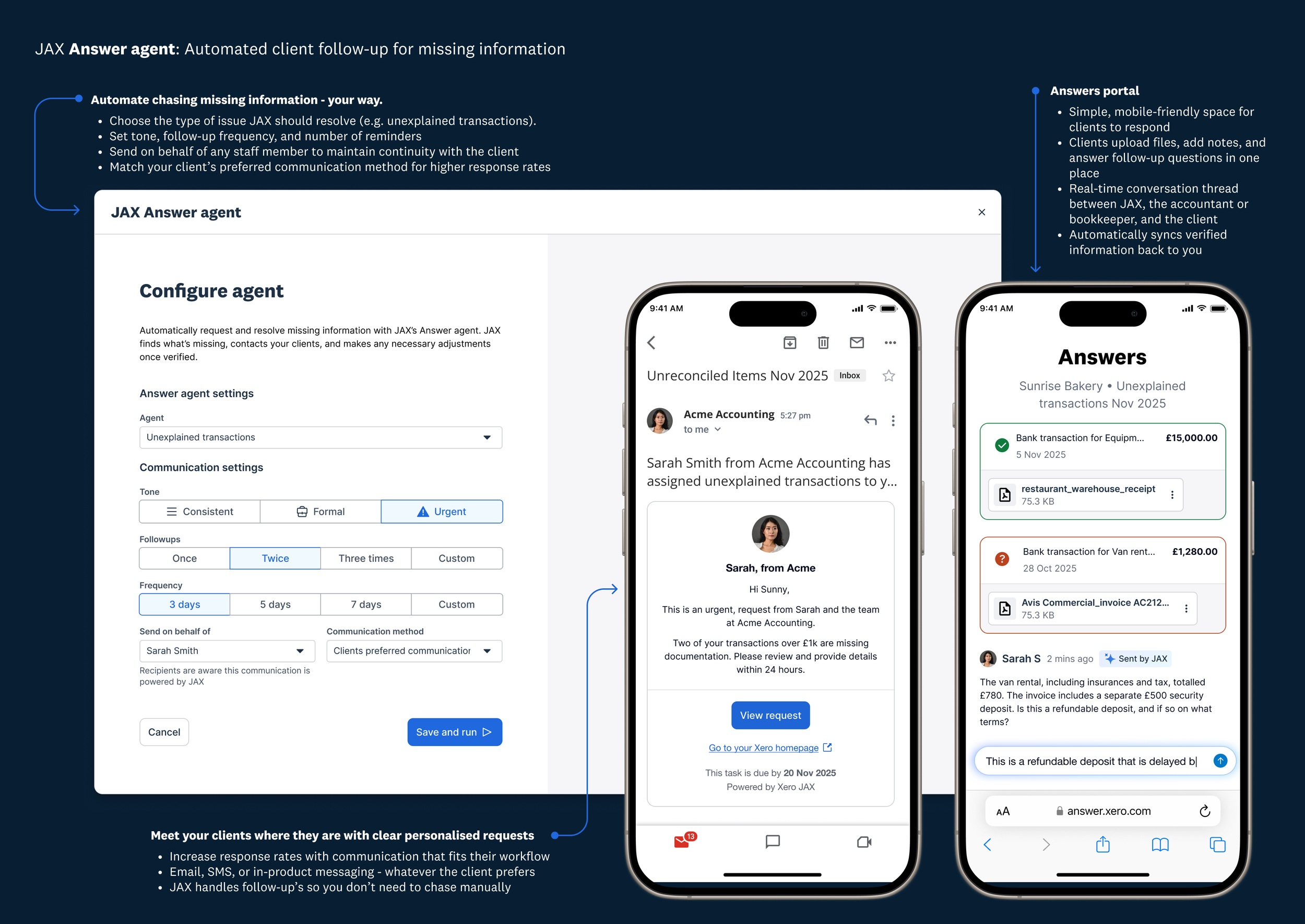
JAX answer agent concept - an AI agent for continuously chasing client for missing information and document needed to do billable work
The problem
Around 40-50% of ABs regularly get stuck waiting on a document or piece of information from a client, which traps them in a manual cycle of chasing. The existing thinking treated this as ad hoc requests, like chasing three missing invoices at month-end. That doesn't scale to a bookkeeper with a hundred clients. I reframed it around agent jobs: standing goals like bank reconciliation, each with its own definition of "ready". Once a job is set up, the agent monitors client data against that definition and starts the conversation itself. Smart batching merges gaps across jobs into one comms plan, so clients get one request, not several.
Designing for trust
In concept testing, 5 of 7 ABs picked document chasing as their favourite feature. It solved a pain their existing tools hadn't. But it touches the client relationship they own, and they weren't ready to hand it over untouched. Three things became non-negotiable:
Review before send. ABs wanted to see everything before it went out, in one central place. Fire-and-forget was a no.
Edit and personalise. A generic AI draft wasn't good enough. ABs wanted formal for corporate clients, warmer for others, and room for personal touches inline.
Control over what's requested. One participant didn't want a generic dollar limit sending them hundreds of documents to find the one that mattered.
I designed a graduated trust model instead of an on/off switch:
Every job starts in approval mode. The AB reviews and approves each message, with inline editing and per-client tone controls.
Messages go out under the individual AB's name, not the practice, to keep the personal relationship clients expect.
After a set number of manual approvals, the AB can unlock autonomous mode for that job.
Redundancy checks flag when a document has likely already arrived, so the agent never asks a client for the same thing twice.
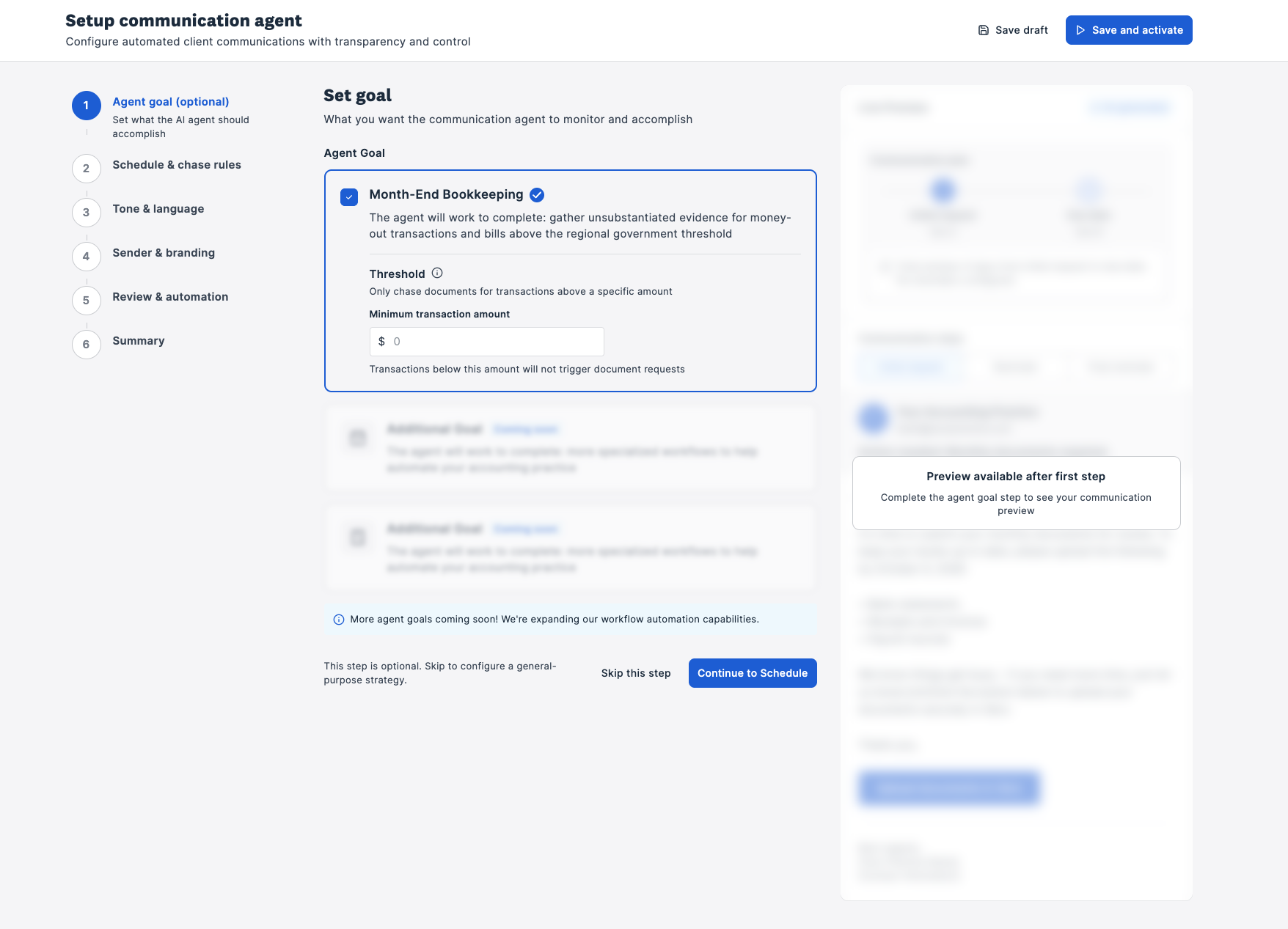
Set up goals like month-end bookkeeping for the agent to continuously monitor and resolve
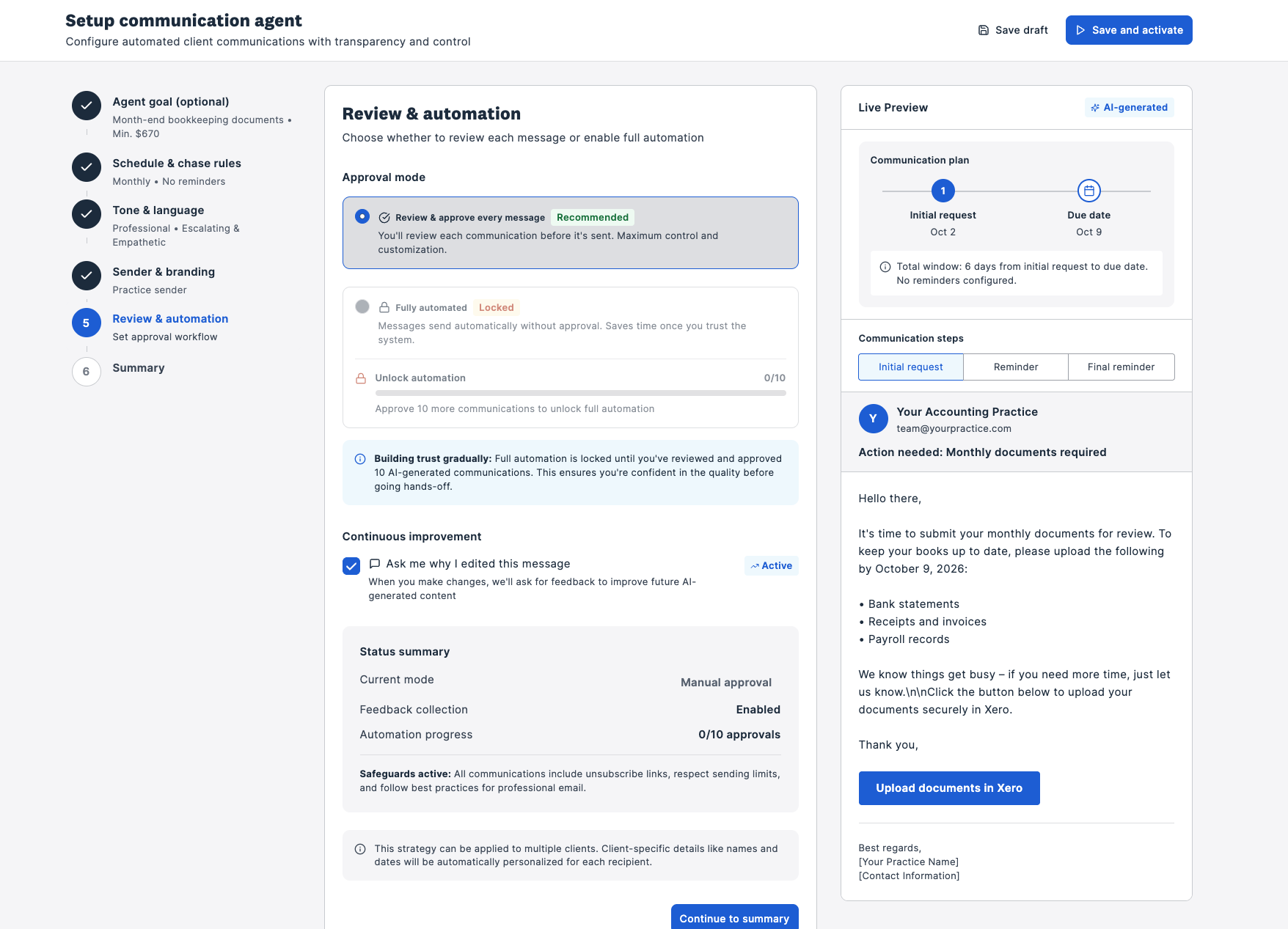
Initially setup with review and approval by the user to build trust before unlocking agent autonomy
What I cut
My first direction was a one size fits all clients: a single threshold cutoff for all requests. It tested well as a simplicity story, then fell apart against real clients. A construction client needs every receipt for compliance, while another only matters above a certain value. I pivoted to a per-client configuration, trading simplicity for something that matches how practices think about risk.
Result
In a research panel customers chose document chasing over everything else when tested against other agentic and AI feature concepts. The concept was meet the positivity and a healthy dose of criticism.
“Everybody wants [this] now… This would be transformative”[My client would go] Hey, your bot just keeps hitting me up…”
A version of this feature is shipping in Xero Partner Hub, where JAX automatically identifies transactions missing a receipt. The work also pulled me into Xero's AI and agentic strategy group to represent the accounting and bookkeeping lens.
Learnings and open question
Reframing the problem from single requests to ongoing jobs is what made batching and autonomy possible at scale across hundreds of clients.
Trust needs to be consciously designed for across the end-to-end user journey.
The open question is the client side: we tested the AB experience, not the small business owners receiving the requests. ABs were clear it has to be just as easy for their clients otherwise it all falls apart, so that's the most important next piece of research.